
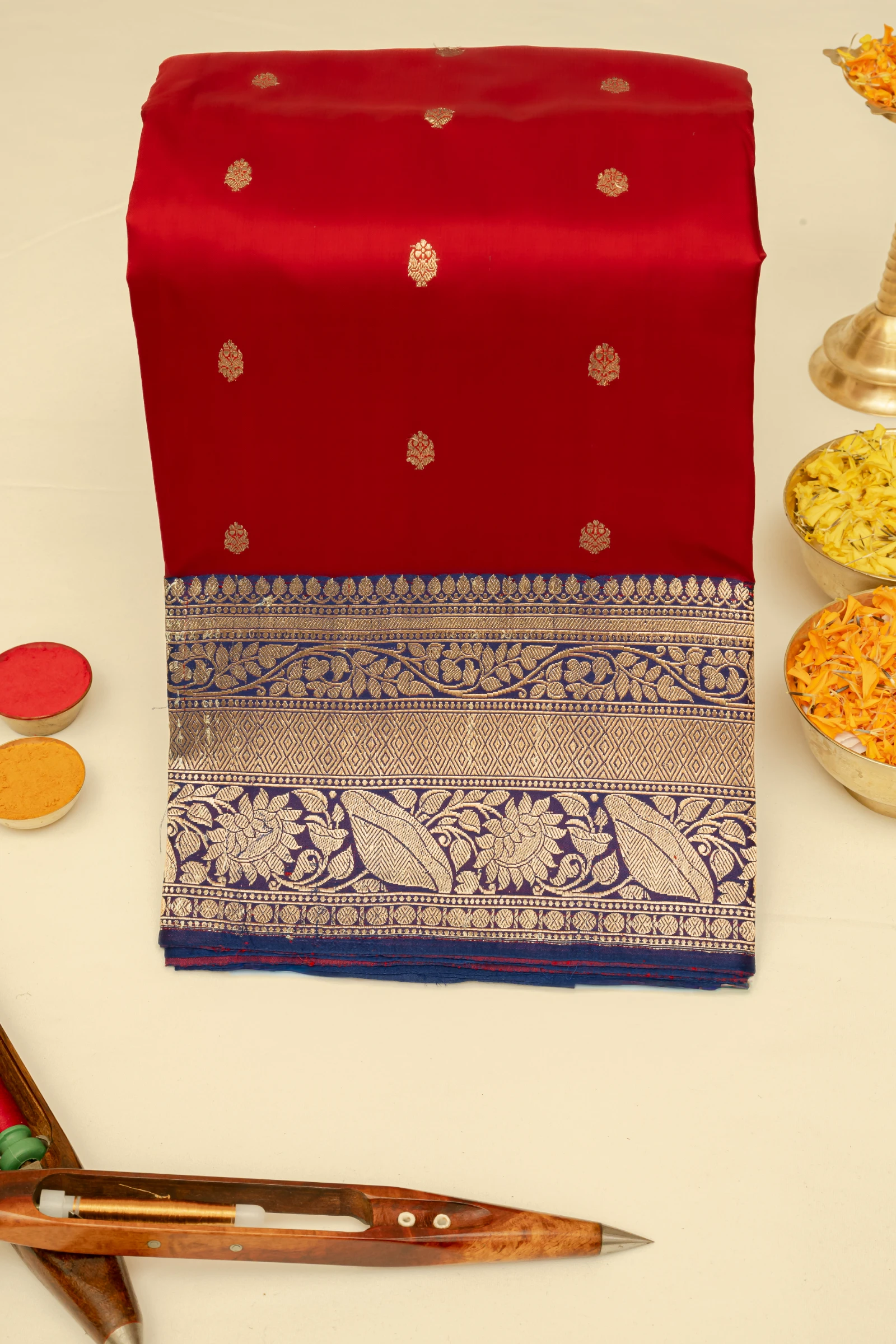
At first glance, a Kantha saree may look delicate, soft, and beautifully embroidered.
But what most people don’t realize is this:
A single authentic Kantha saree can take months to complete.
Yes — months.
Let’s understand why.
What Is Kantha Work?
Kantha is a traditional hand embroidery technique that originated in the villages of West Bengal.
It began as a form of storytelling.
Women would layer old cotton sarees together and stitch them using simple running stitches, creating intricate patterns inspired by:
- Nature
- Folk tales
- Daily village life
- Spiritual symbols
Over time, this humble practice evolved into one of India’s most celebrated embroidery traditions.
But the process remains entirely handmade.
Every Stitch Is Done by Hand
Unlike machine embroidery, Kantha work is created using a simple needle and thread.
There is no automation.
No shortcuts.
No digital patterns.
An artisan carefully inserts thousands — sometimes lakhs — of tiny running stitches across the entire saree.
Each motif is built slowly, stitch by stitch.
This alone requires extraordinary patience and skill.
The Entire Saree Is Covered with Stitching
In many authentic Kantha sarees, embroidery is not limited to the pallu or border.
The stitching spreads across the entire body of the saree.
This creates:
- Texture
- Depth
- Soft rippling patterns
- A distinct handcrafted feel
Because of this extensive coverage, completing the embroidery takes weeks or even months, depending on the design complexity.
Detailed Motifs Take Time
Traditional Kantha sarees often feature:
- Floral vines
- Birds and animals
- Geometric patterns
- Mythological scenes
Complex storytelling motifs require careful planning before stitching begins.
Artisans must maintain symmetry and spacing manually — without printed guides in many cases.
Precision like this cannot be rushed.
It Is Often Made by Rural Women
Kantha embroidery is largely practiced by women in villages.
Many artisans balance embroidery with household responsibilities.
They work at a steady, sustainable pace — often stitching a few hours a day.
This is not factory production.
It is slow, mindful craftsmanship.
Natural Fabrics and Dyes Add to the Process
Authentic Kantha sarees are usually made on:
- Pure cotton
- Silk blends
- Natural-dyed fabrics
Preparing the base fabric, washing it, and ensuring it is ready for embroidery takes additional time.
The final result is breathable, skin-friendly, and long-lasting.
No Two Kantha Sarees Are Ever the Same
Because everything is done by hand:
- Stitch density varies slightly
- Motifs carry personal touches
- Minor irregularities reflect authenticity
These variations are not flaws.
They are proof of human craftsmanship.
And uniqueness cannot be mass-produced.
Why This Time Makes It Valuable
When a Kantha saree takes months to complete, you are not just buying embroidery.
You are investing in:
- The artisan’s time
- Generations of inherited skill
- Cultural storytelling
- Sustainable fashion
In a world of fast fashion, Kantha stands for patience.
It represents a slower, more meaningful way of creating beauty.
A Kantha Saree Is Not Just Worn — It Is Felt
When you drape a Kantha saree, you feel the texture of thousands of stitches.
You feel the softness shaped by human hands.
You carry months of dedication in every fold.
That is why Kantha sarees take months to complete.
And that is why they are truly priceless.