
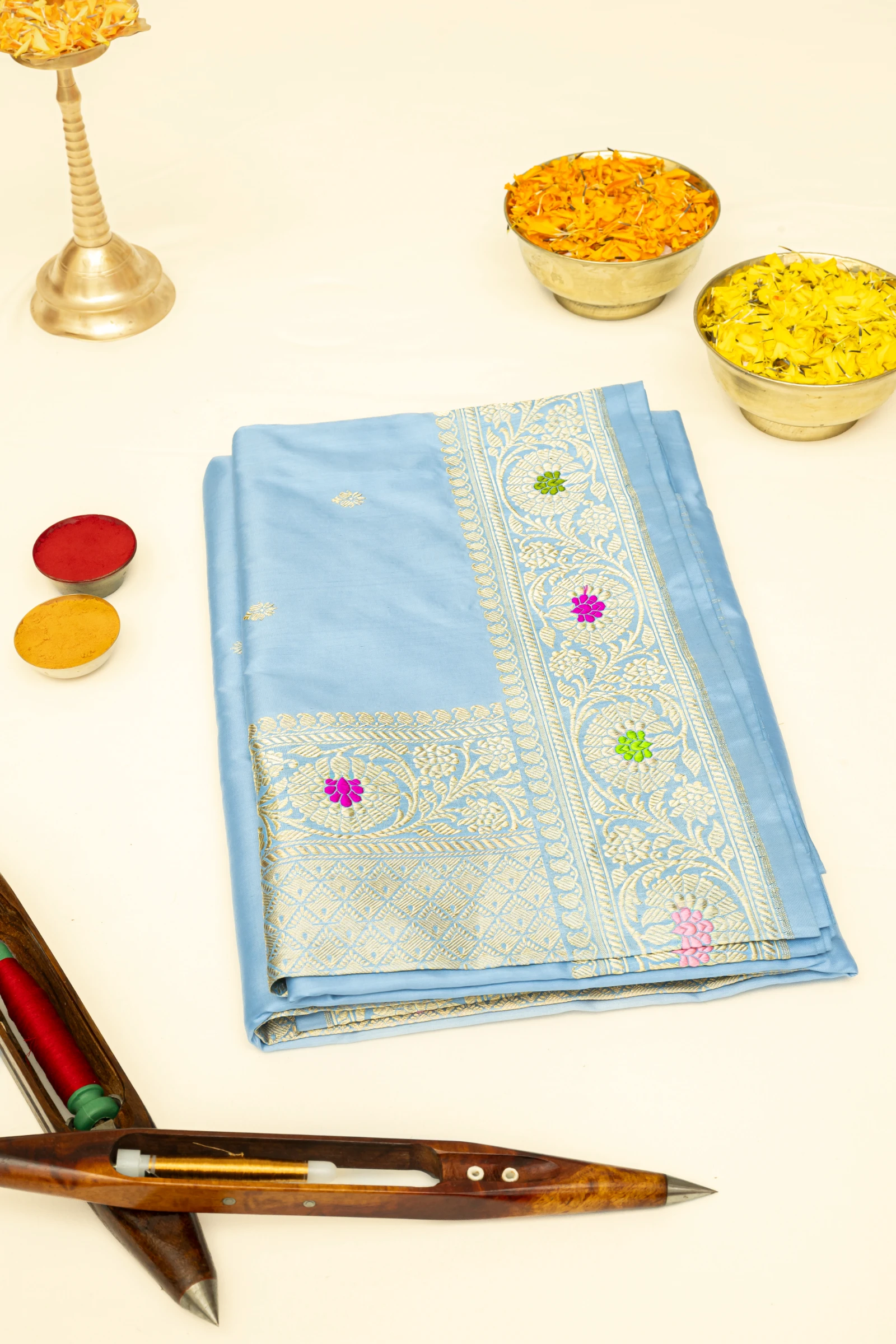
In 2022, what began as a simple dream — to start a saree business — turned into something much deeper.
We didn’t just want to sell sarees. We wanted to understand them.
What we discovered changed us forever.
We realized that India is not just a country of textiles — it is a living museum of handloom traditions. Every state carries its own story, its own technique, and its own cultural identity woven into fabric.
And so, our journey began.
The East: West Bengal – Where Threads Hold Centuries of Dedication
Our first destination was West Bengal.
Here, we witnessed the magic of Handloom Jamdani weaving — a craft that demands intense concentration and unmatched skill. Each motif is inserted by hand, thread by thread, without mechanical shortcuts. Watching artisans work on a Jamdani loom felt like witnessing meditation in motion.
We also met village women creating Kantha sarees, where months of delicate hand stitching transform plain fabric into storytelling canvases.
Near Kolkata, we explored traditional Aari work embroidery. Unlike machine embroidery that finishes in hours, these handcrafted masterpieces can take weeks or even months, depending on intricacy.
This was our first realization:
Handcrafted sarees are not products — they are time, patience, and devotion woven together.
The North: Varanasi & Mubarakpura – Royalty in Pure Silk
Our journey then took us to the sacred city of Varanasi, home of the legendary Banarasi saree.
Today, markets are flooded with powerloom versions. But we chose a different path — partnering only with handloom weavers who continue the tradition of weaving pure Katan silk Banarasi sarees.
A single authentic piece can take months to complete. The zari work, the silk quality, and the detailing — nothing is rushed.
In Mubarakpura, near Azamgarh, we were proud to see many talented women leading the weaving process. Their dedication reminded us why preserving handloom matters.
This wasn’t just silk.
This was heritage.
Central India: Chanderi & Maheshwar – Weaving Air and Royal Legacy
In Chanderi, Madhya Pradesh, we encountered sarees so lightweight they felt like woven air. The intricate patterns and delicate transparency make Chanderi globally admired.
Nearby in Maheshwar, we explored the legacy of Queen Ahilyabai Holkar, who revived and nurtured the Maheshwari weaving tradition in the 18th century. The silk-by-cotton blends create a perfect balance of elegance and comfort.
These towns may be small.
But their contribution to Indian heritage is monumental.
Rajasthan & Gujarat: The Art of Natural Dye & Block Printing
Our journey continued west to Rajasthan and Gujarat — lands of color and craft.
Here, we immersed ourselves in Ajrakh and Bagru hand block printing, Bandhani, Shibori, and Lehariya traditions.
What stood out most was the natural dye process.
While chemical pigment printing can finish in 2–3 days, natural dyeing takes 15–20 days. It involves multiple stages of washing, drying, dyeing, and re-dyeing.
Why choose the harder path?
Because natural dyes:
- Are gentle on the skin
- Are environmentally friendly
- Age beautifully over time
This is slow fashion in its truest form.
Beyond the Loom: Our Journey Continues
Since 2022, we have also traveled to:
- Kerala for the elegant Kasavu sarees
- Ponduru in Andhra Pradesh
- Sircilla in Telangana
- And countless other villages
Each place taught us something new — about patience, pride, and the quiet strength of India’s artisans.
After two years of research, relationship-building, and understanding processes deeply, we began bringing these handcrafted sarees to you.
Today, we are proud to share them online.
What This Journey Taught Us
- Handloom is not a trend — it is legacy.
- Premium pricing reflects time, skill, and authenticity.
- Supporting artisans means preserving culture.
- Every saree carries months of someone’s life within it.
When you wear a handcrafted saree, you don’t just wear fabric.
You wear a story.
You wear heritage.
You wear India.
Leave a Reply